

Ask and You Shall Be Given
Mastering Prompt Engineering for Improved AI Output

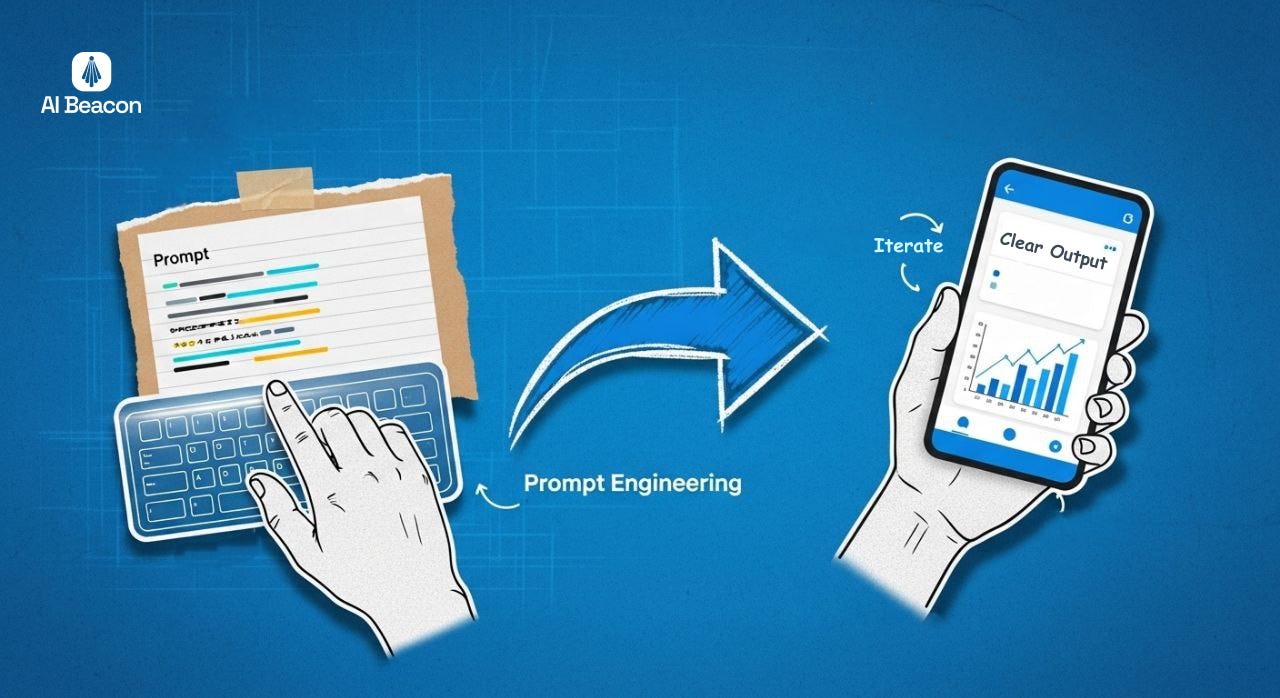
For decades, talking to computers meant learning their language, code. If you wanted results, you had to think like a programmer: precise syntax, specific commands, zero ambiguity.
Then AI changed everything. Suddenly, you could just... talk to these systems. Type in plain English and get sophisticated outputs. It felt revolutionary finally, computers that spoke our language.
But here's what nobody tells you: it's not actually natural language. Not really.
You know the feeling. You write what seems like a perfectly clear request, hit enter, and get back something that's... almost right. Close, but not quite what you needed. Maybe completely off-target.
The truth? AI systems still need structure, precision, and strategy, it's just a different kind of programming. Prompt Engineering is that new programming language, and mastering it is the difference between mediocre AI outputs and truly powerful results.
At AI Beacon, I'll show you how to move from casual conversation to engineered communication. We'll start with rock-solid fundamentals, build up to advanced layering techniques, and finish with strategies that will completely transform how you work with AI.
Ready to become fluent in this new form of programming?
I. The Fundamentals: Speaking AI's Language (Basic Prompting Techniques)
Before you can build skyscrapers, you need to understand the bricks. The same goes for AI. These basic prompting techniques are your foundational building blocks, essential for anyone looking to get more out of their AI interactions.
A. Zero-Shot Prompting: Just Ask!
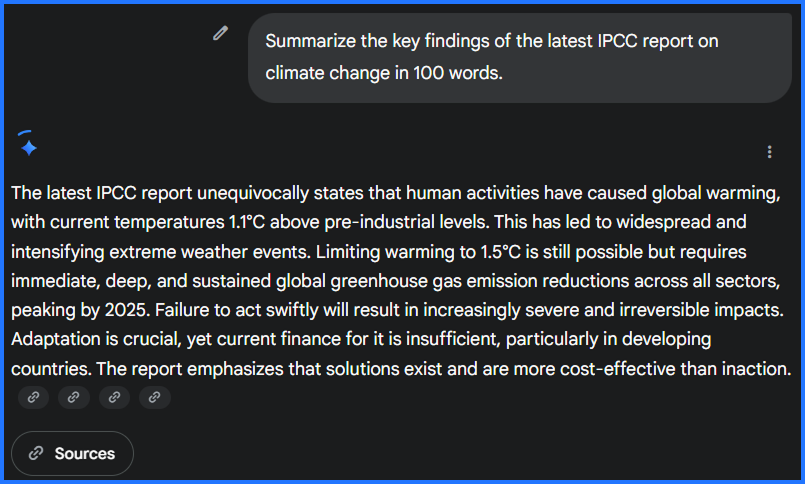
This is the simplest way to interact with an AI model. You just ask a question or give a command, and the AI generates a response without you providing any specific examples of input or output within the prompt itself. The AI uses its vast pre-trained knowledge to try and figure out what you want.
When to use it: For straightforward tasks, general knowledge queries, or when you trust the AI to interpret your intent directly. It’s your quick and easy go-to.
Example Prompt:
Summarize the key findings of the latest IPCC report on climate change in 100 words.
B. One-Shot Prompting: A Little Hint Goes a Long Way
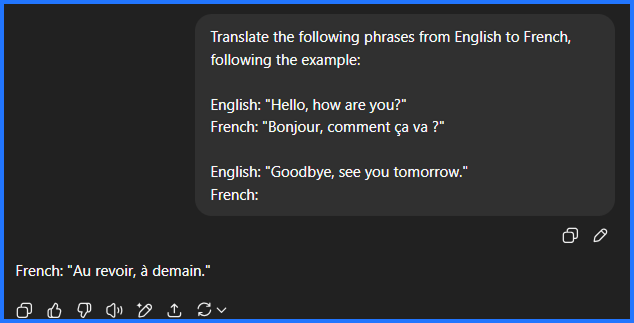
Sometimes, the AI needs a little nudge, a gentle guide for the style or format you're looking for. With one-shot prompting, you provide one single example of an input-output pair right within your prompt. This helps the AI understand the pattern you're trying to establish.
When to use it: When the output format is specific, the desired style is nuanced, or if the AI might struggle with ambiguity on its own. It’s like giving it a clear blueprint for just one instance.
Example Prompt:
Translate the following phrases from English to French, following the example:

English: "Hello, how are you?"
French: "Bonjour, comment ça va ?"

English: "Goodbye, see you tomorrow."
French:
C. Few-Shot Prompting: Setting a Clear Pattern
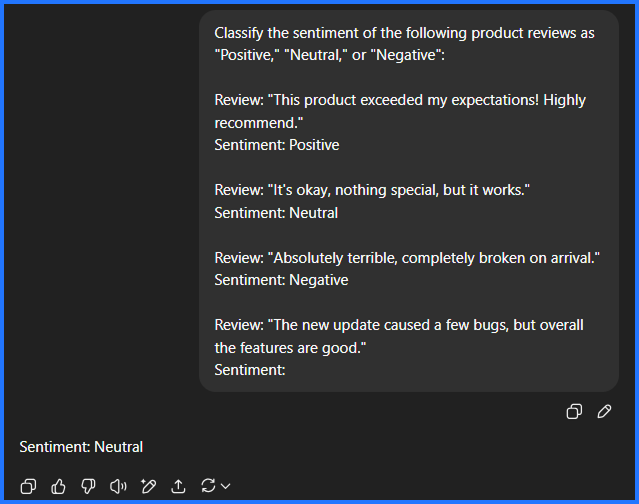
This builds on one-shot prompting. Instead of just one example, you provide multiple examples (say, 2-5) within your prompt. This establishes an even clearer pattern, demonstrating a range of desired behaviors or guiding the AI through a more complex transformation.
When to use it: For more complex transformations, when you have highly specific output requirements, or when you're essentially "training" the AI on a micro-task within the prompt itself. The more examples, the clearer the pattern for the AI.
Example Prompt:
Classify the sentiment of the following product reviews as "Positive," "Neutral," or "Negative":

Review: "This product exceeded my expectations! Highly recommend."
Sentiment: Positive

Review: "It's okay, nothing special, but it works."
Sentiment: Neutral

Review: "Absolutely terrible, completely broken on arrival."
Sentiment: Negative

Review: "The new update caused a few bugs, but overall the features are good."
Sentiment:
II. Layering Your Prompts: Adding Depth & Precision (The Art of the 'Context Stack')
Alright, this is where you start to feel like a true prompt engineer. Instead of just firing off a single command, you're going to learn to build a "stack" of instructions. Think of it like giving your AI a rich, multi-layered understanding of its role and your desired outcome. This is where you move from basic requests to highly precise, nuanced results.
A. The Persona Layer: Who Are You, AI?
This is where you tell the AI to "act as" a specific role, expert, or even a fictional character. It instantly shifts its tone, knowledge base, and overall approach. You'd use fragments like: "Act as a seasoned venture capitalist..." or "You are an award winning copywriter"
B. The Structure Layer: What Should It Look Like?
This layer is all about defining the exact format, length, and organization of the AI's output. No more guessing games. You can specify things like: "...Provide a 5-point bulleted list in Markdown, with each point starting with an emoji."
C. The Context Layer: What Do You Need to Know?
This is where you load the AI with all the necessary background information, relevant details, or constraints it needs to fully understand your specific problem. It prevents generic responses and ensures the AI operates within your reality. For instance: "...The target audience is small business owners with limited technical knowledge. Our product is a B2B SaaS platform for..."
D. The Constraint Layer: What Not To Do (And What to Limit)?
This is about setting clear boundaries. You explicitly tell the AI what to avoid or define strict limits, like a word count, forbidden topics, or specific style elements. It refines the output and keeps it on track: "...Do not use any jargon. Keep the response under 150 words. Avoid sounding like a robot."
E. The Audience Layer: Who Are You Talking To?
Finally, specify the intended reader or listener for the AI's output. This subtly but powerfully influences the AI's tone, complexity, and vocabulary. Think: "...Explain this concept to a high school student." or "...Write a professional email to a CEO."
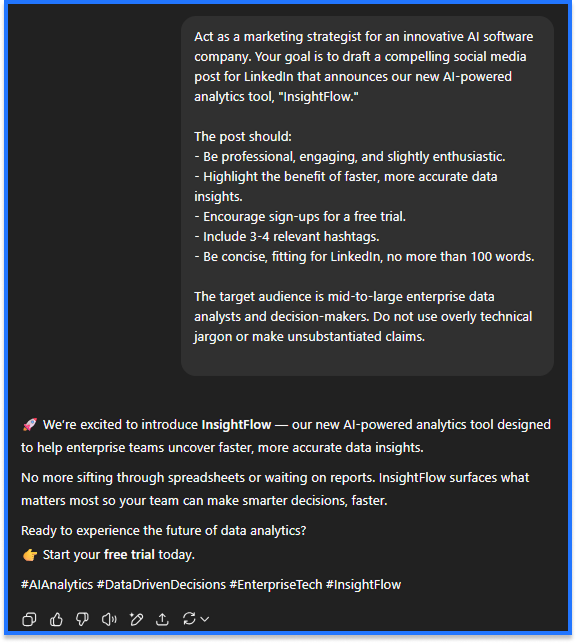
When you combine these layers, you get something far more powerful. Here's what a fully layered prompt might look like, and the kind of output it produces:
Example of a Layered Prompt:
Act as a marketing strategist for an innovative AI software company. Your goal is to draft a compelling social media post for LinkedIn that announces our new AI-powered analytics tool, "InsightFlow."

The post should:
- Be professional, engaging, and slightly enthusiastic.
- Highlight the benefit of faster, more accurate data insights.
- Encourage sign-ups for a free trial.
- Include 3-4 relevant hashtags.
- Be concise, fitting for LinkedIn, no more than 100 words.

The target audience is mid-to-large enterprise data analysts and decision-makers. Do not use overly technical jargon or make unsubstantiated claims.
III. Advanced Hacks: Supercharging Your AI Interactions
You've mastered the fundamentals, and you're building prompts with depth. Now, let's explore some clever "hacks" that go beyond the obvious. These are little tricks that can turn your AI into an even more powerful assistant for specific goals, whether you're learning, refining, or brainstorming.
A. For Learning & Deepening Understanding:
Hack 1: The "Explain Like I'm Five (ELI5)" Method:
How it works: This is exactly what it sounds like. "Explain this to me like I'm 5 years old" to any complex topic. The AI will instantly simplify the language, use analogies, and break down the concept to its bare essentials. It’s brilliant for grasping core ideas quickly.
Why it's powerful: It's your instant jargon-cutter. It ensures you understand the foundational principles before diving into the weeds.
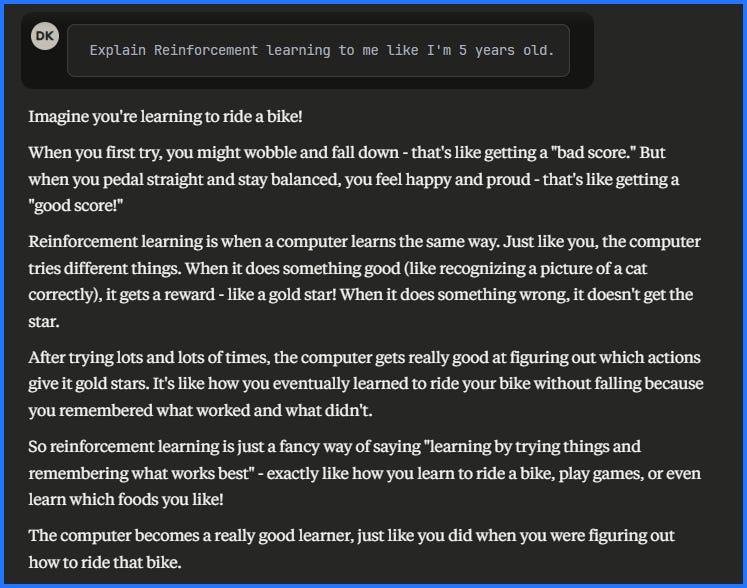
Example Prompt (and anticipated output):
Generated code
Explain Reinforcement learning to me like I'm 5 years old.
Hack 2: The "Teach Me Better" Loop (Iterative Learning):
How it works: This turns the AI into your personalized tutor. You present your current understanding of a topic ("Here's what I know about X...") and then ask the AI to review, correct, expand, and refine your explanation to make it clearer or more accurate. It's a fantastic feedback loop.
Why it's powerful: It actively polishes your knowledge, identifies gaps in your understanding, and helps you articulate complex ideas more precisely. You're not just consuming; you're actively learning and refining.
B. For Polishing & Refining AI Output (When You're Not Satisfied):
Hack 1: AI-Powered Self-Critique (Internal Refinement):
How it works: After the AI generates content, don't just accept it. Follow up immediately with a prompt like: "Rank your previous response on a scale of 1-10 for clarity, creativity, and conciseness. Then, provide specific feedback on how I could prompt you to make it even better, and then re-generate it."
Why it's powerful: This is meta-prompting! You're teaching yourself how to prompt better by getting feedback directly from the AI on its own limitations and potential. It's like having an internal coach.
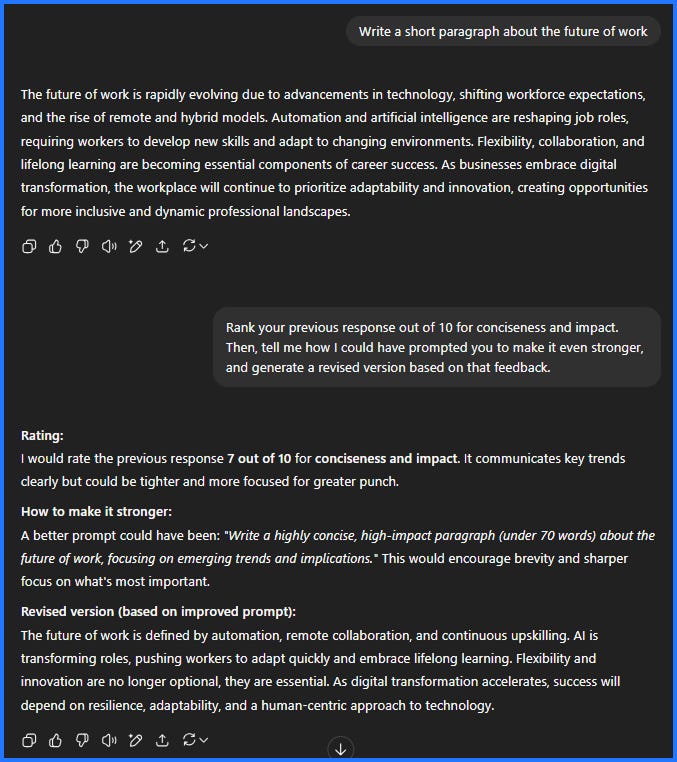
Example Prompt (following a previous output, implying you've just received it):
Generated code
Rank your previous response out of 10 for conciseness and impact. Then, tell me how I could have prompted you to make it even stronger, and generate a revised version based on that feedback.
Hack 2: Cross-Model Critique (AI vs. AI for Improvement):
How it works: This takes the concept of self-critique a step further. You take the output from one AI model (say, ChatGPT) and feed it into a completely different AI model (perhaps Claude, or Gemini). Then, you ask the second model to "Act as a professional editor. Critically evaluate this text for X, Y, Z (e.g., tone, persuasiveness, grammar). Then, provide specific suggestions for improvement and a revised version."
Why it's powerful: Each AI model has slightly different strengths and biases. By leveraging multiple architectures, you get varied perspectives and a truly refined, higher-quality output. It's like having a team of AI editors.
C. For Idea Expansion & Brainstorming (When You Have a Rough Sketch):
Hack 1: The "Brainstorm Multiples" / "What If" Approach:
How it works: Provide your rough idea, initial concept, or even a single keyword. Then, simply ask the AI to "Expand on this idea in 5 distinct ways," or "Brainstorm 3 'what if' scenarios for this concept," or "Generate 10 different angles for this topic for a blog post."
Why it's powerful: This hack is a massive creative block-buster. It rapidly generates a diverse range of options, helping you explore paths you might not have considered on your own. It's like having an endless brainstorming session.
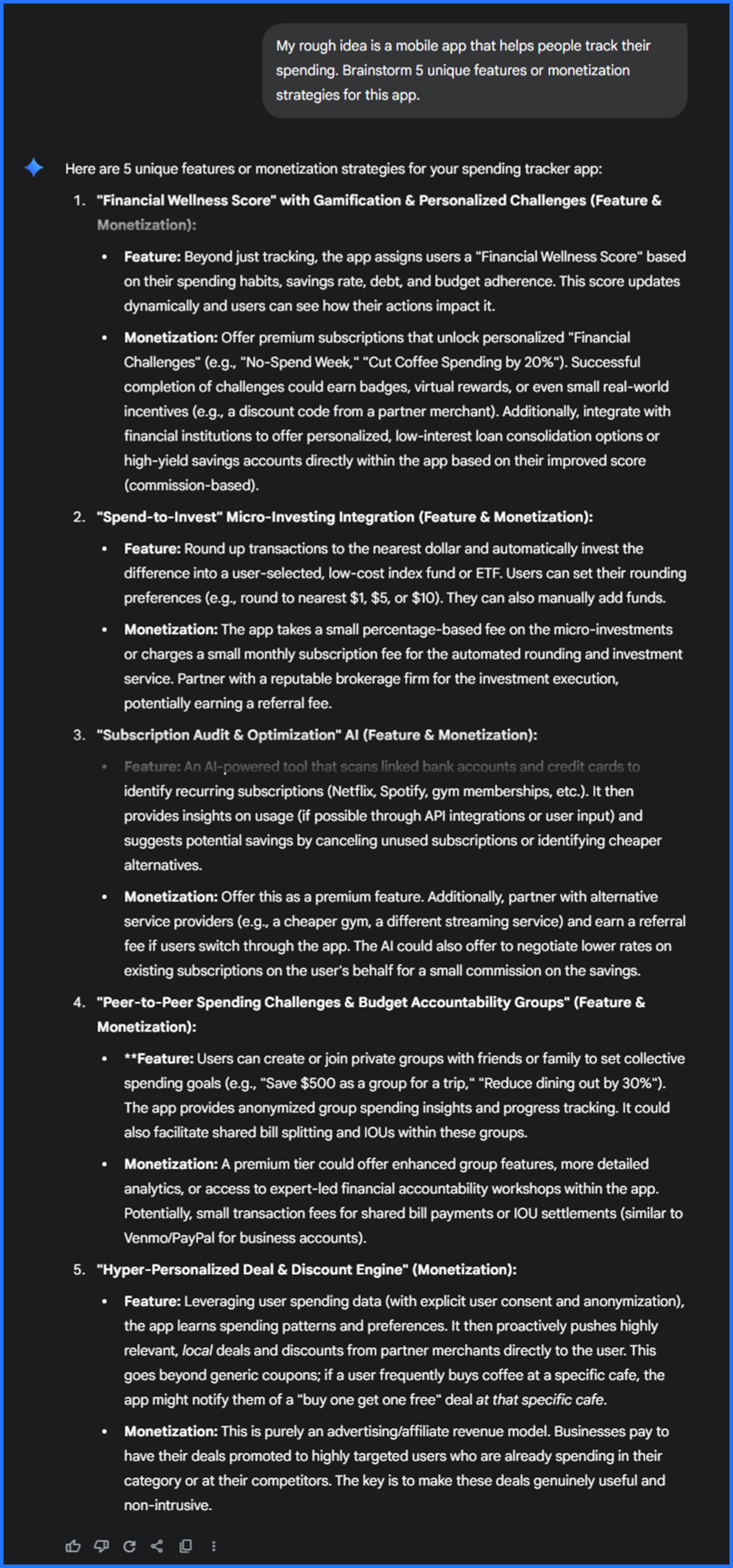
Example Prompt:
Generated code
My rough idea is a mobile app that helps people track their spending. Brainstorm 5 unique features or monetization strategies for this app.
D. For Planning & Strategizing (When You Need a Roadmap):
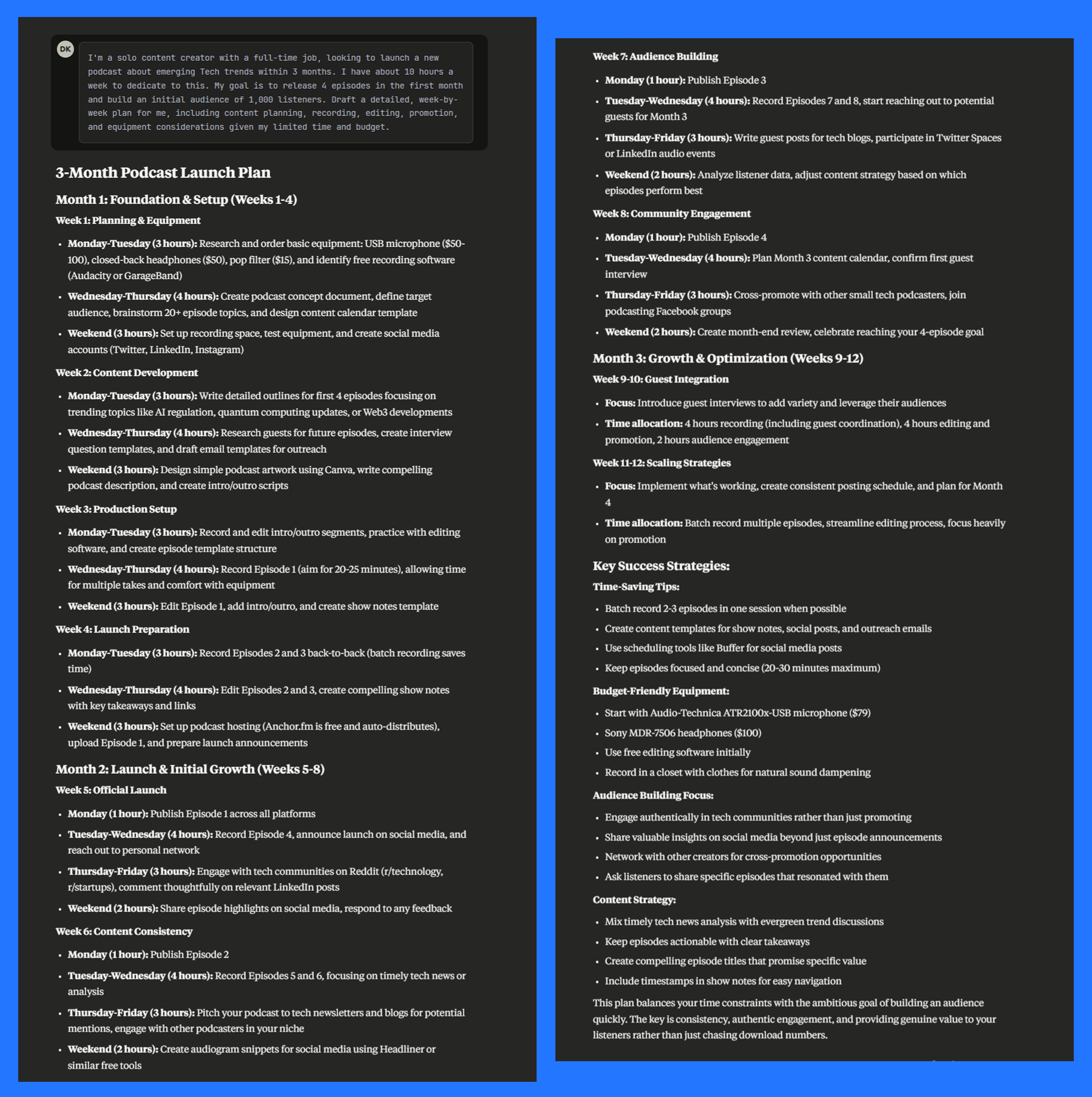
Hack 1: The "Contextual Planner":
How it works: This is about turning the AI into a personalized strategic consultant. Provide comprehensive context about yourself (your role, skills, available resources), your goal (the desired outcome, why it matters to you), and your constraints (timeline, budget, limitations). Then, ask the AI to generate a detailed, actionable plan tailored specifically to your unique situation.
Why it's powerful: It transforms the AI from a general knowledge base into a custom roadmap generator. It helps you map out complex projects, personal goals, or even career transitions with precision that standard templates can't offer.
Example Prompt:
I'm a solo content creator with a full-time job, looking to launch a new podcast about emerging Tech trends within 3 months. I have about 10 hours a week to dedicate to this. My goal is to release 4 episodes in the first month and build an initial audience of 1,000 listeners. Draft a detailed, week-by-week plan for me, including content planning, recording, editing, promotion, and equipment considerations given my limited time and budget.
V. Conclusion: Your Prompting Journey Begins Now
Prompt engineering is far more than just a clever trick; it’s a fundamental skill for the AI age. It’s about clear communication, strategic layering, and leveraging smart "hacks" to push AI's capabilities further than you might have thought possible.
By actively applying these techniques, you're not just using AI; you're truly partnering with it. You'll move from getting generic answers to pulling out precise, insightful, and genuinely valuable output tailored to your exact needs.
The best way to learn any new skill is by doing. Don't just read about these methods – try them out today. Experiment, combine layers, play with the hacks. You’ll be amazed at the level of precision and power you can unlock.
This is just the beginning of our journey together to unlock AI's true potential. Stay tuned to AI Beacon for deeper dives and more practical insights on navigating the AI frontier.